



It is Saturday night and the setlist document is still blank. You have five songs in mind but no idea of the order. Open big or build slowly? Two songs in the same key, lazy or intentional? And what happens at the moment the fast song ends and the reflective one begins?
A setlist is more than a list of songs. It is the shape of the music in the service. This guide pulls together published advice from Worship Online, Band Central and Leaders.Church on how to build a Sunday set that flows: the arc, keys, tempo, the space between songs and the preparation that makes it work.
Start with the arc, not the songs
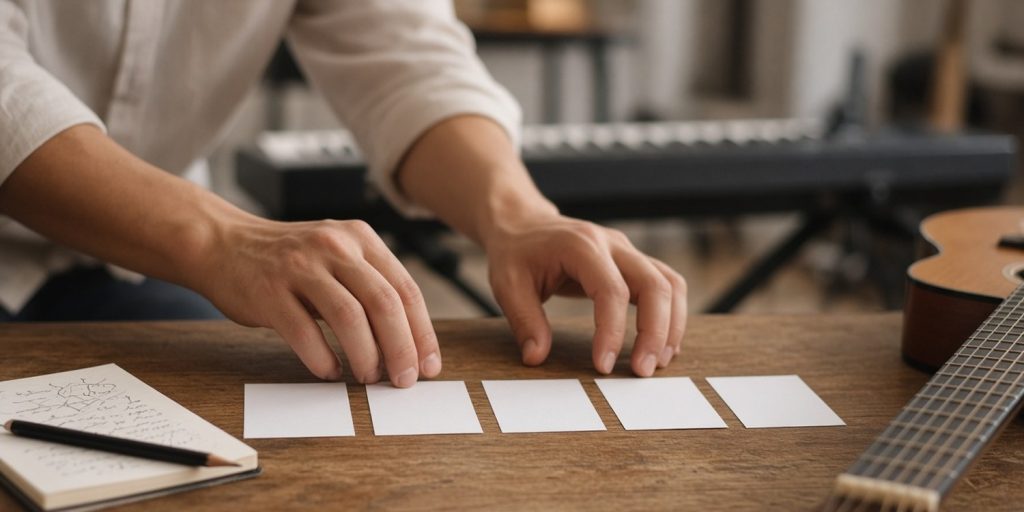
Worship Online says most leaders start by opening a streaming app, picking five songs they like and arranging them by feel. Its advice is to decide where you want the congregation to start and end before you choose anything.
It describes a common arc: gathering (energy, declaration), engagement (deeper lyrics, mid-tempo), response (intimacy, surrender) and sending (confidence, resolve). Band Central describes a similar one: one or two gathering songs that are familiar and easy to sing, one or two praise songs, a transition, one or two songs of worship that use more personal language, and sometimes a response song that ties into the sermon. Both say it is a starting framework, not a formula.
Both also start from the same place: what is this service about? Band Central suggests asking about the sermon theme, the emotional journey you want, whether the service is celebratory or reflective, and whether communion, baptism or prayer time will affect the flow.
Choose songs for a reason
Worship Online suggests three questions before a song goes in:
- What posture does this song create (declaration, lament, surrender, joy)? If two consecutive songs create the same posture, one may need to move.
- Does it fit your congregation right now?
- Can your team play it well? A mediocre performance of a great song is worse than a great performance of a simple one.
It also recommends a limit on new material: one new song per set, with the rest familiar. Band Central's guide suggests a similar balance, introducing one new song at a time and repeating it over several weeks. Both are published recommendations from planning-tool vendors, so treat the exact ratios as a starting point and adjust to your team.
On length, Worship Online says four to six songs is standard for most churches, which it puts at roughly 20 to 30 minutes of music, and that the number matters less than the flow.
Keys: neighbours, not strangers
Both guides treat key relationships as one of the most overlooked parts of planning.
- Worship Online's rule: consecutive songs should share a key or sit in closely related keys, such as a half step or whole step apart, or relative major and minor. A set that goes from G to E-flat has a problem.
- Band Central lists how keys feel: the same key is seamless, a half step up gives lift, a fourth or fifth away (G to C, D to A) connects smoothly, and distant keys need a clear break such as talking, prayer or a pad.
Worship Online suggests three fixes for a clash: transpose one of the songs, reorder so conflicting keys are not adjacent, or bridge the gap with a pad, a chord walk or a moment of spoken word. Band Central adds that you can transpose to improve flow rather than always playing the original key.
One caution: the best key for the flow of the set is not always the best key for singing. If you change a key to join two songs, check the melody range for the congregation too. Our guide on choosing the key for your congregation explains how.
Tempo and energy
Worship Online says that tempo and energy are what people feel in their body. It recommends writing the BPM next to the key for every song and then looking at the shape. Does it build, descend gradually, or spike and crash?
Its example pattern: start with energy at about 120 to 140 BPM, sustain it for one or two songs, then bring the tempo down gradually as you move into response. Avoid putting the slowest song right after the fastest. It also points out that energy is not only tempo: a song at 110 BPM can feel huge with a full arrangement and a song at 130 BPM can feel restrained when the band plays dynamically.
Band Central suggests a simple map with five columns: position, song, key, BPM and energy. When you can see the curve, gaps are obvious. Two high-energy songs followed by a slow ballad with no transition show up on paper instead of on Sunday morning.
| Position | Song | Key | BPM | Energy |
|---|---|---|---|---|
| 1 | ||||
| 2 | ||||
| 3 | ||||
| 4 | ||||
| 5 |
Not every set should start fast. Worship Online says a reflective opening can be right in a season of lament or after a difficult week, and that the moment should guide the choice.
Plan the space between songs
Worship Online says transitions reveal your preparation more than your songs do, and that for each one you should decide among three options: flow straight into the next song, use a musical bridge such as a pad or ambient guitar, or use spoken word or prayer to reset the room. Write the decision down. If you are flowing directly, the band needs to know the exact moment and the exact chord.
Leaders.Church calls transitions the most overlooked rehearsal component and offers specific techniques for common problems.
- An odd key change (for example C to B): sing the chorus of the first song a cappella a couple of times, then fade in a pad or keys in the new key. Another option is a drums-only groove: end on the tonic, click off the next tempo and let the drummer play four bars before the new song.
- Keys that share a chord: end on the shared chord, often the 4 or 5, and let it become the new tonal centre. For C to F, end on F and swell. For C to G, end on G.
- Fast song to fast song in a different key: leave no dead space. Count off the next song before the crash ending has faded and play the downbeat with confidence.
- Up-tempo to slow: do not switch abruptly. Sing the chorus of the fast song one or two more times at a slower tempo with keys and guitar swells only, which lowers the intensity and previews the new mood.
- Into a slower song, and between slow songs: give each ending a clear signal, with soft swells and a slight slowing, so the congregation knows whether you are repeating the chorus or moving on.
- Longer endings on fast songs: Leaders.Church suggests extending a crash ending to fifteen to twenty seconds so people can respond, and so the band has time to change a pedal or add a capo.
It also says that speaking should layer over the transition rather than start after it: say or read something just before one song ends and continue past the intro of the next. And it adds a reminder that you do not need to speak between every song.
Communicate the set so the team can prepare
A well-built set fails if the team does not know it. Worship Online says to send the setlist by Wednesday, and to include for every song the title, key and BPM, transition notes, arrangement changes from the recording and each musician's part. Sending a link and saying "learn this" is not preparation.
If a song has to change late, Worship Online recommends a replacement in the same key and a similar tempo, and sending the change with full details rather than only a title. If the team cannot learn a song in time, pull it.
Band Central lists habits that help: plan transitions explicitly, rehearse them as well as the songs, talk to the pastor by midweek about the sermon topic, and note after every service which songs landed. For how to use rehearsal time, see our guide to a worship team rehearsal in under two hours.
How Planify can help
A good set still needs the right people in the right places.
- Positions for each role. Create positions such as vocals, keys, guitar, bass, drums and sound in your music department. Each position can have a minimum and a maximum number of people, and a coordinator.
- Monthly rota. The planner proposes assignments with attention to fairness and to unavailable periods.
- Confirmation by tap. Musicians confirm or decline on WhatsApp, so you know early if the drummer is out and the song with the drum intro needs to change.
- Cover from the same position. If someone declines, Planify can ask colleagues who cover that position.
- Announcements. Send a short message to a department or position, for example when the setlist changes.
Planify does not build setlists. It handles who is scheduled to play them.
Which features you get depends on your plan.
Read next: how to choose the key for your congregation.
FAQ
How many songs should a worship set have?
Worship Online says four to six songs is standard, which it puts at about 20 to 30 minutes of music. The flow matters more than the number.
Should a worship set always start with a fast song?
No. Starting with energy gathers the room in many services, but a reflective opening can fit a season of lament or a hard week.
How do I move between songs in different keys?
Transpose one of them, reorder the set, or bridge the gap with a pad, a chord walk, spoken word or prayer. Leaders.Church also suggests a cappella choruses and drum-only grooves for awkward key changes.
How often should I introduce a new song?
Worship Online suggests one new song per set. Band Central suggests one at a time, repeated over several weeks.
When should the setlist go to the team?
Worship Online recommends Wednesday at the latest, with keys, BPM, transition notes and part assignments.