


Many volunteer meetings do not need to be meetings. Others are the only time all year the team is in the same room.
A volunteer team meeting is not a staff meeting. People come after work, with family waiting, and give their time freely. If it feels long, vague or repetitive, they stop coming, and then the meeting does not work either.
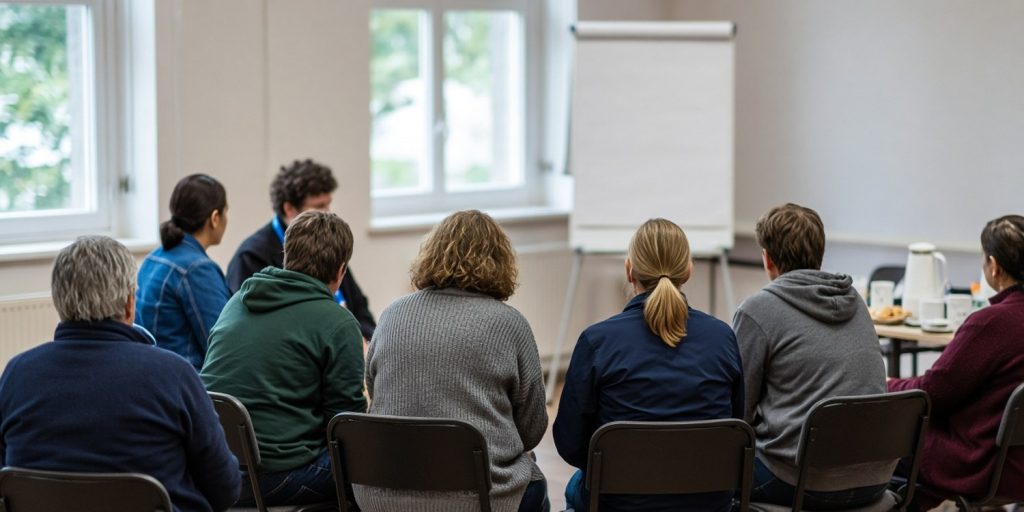
This article explains what a volunteer meeting is for, how to structure one so that it respects people's time and gives three sample agendas you can adapt: a 30-minute team huddle, a pre-event briefing and a quarterly review.
Key takeaways
- Hold a meeting only when you need a conversation. Information alone can go in a message.
- A meeting for volunteers should be short, start and end on time and finish with clear actions.
- Put thanks and stories at the start, not as an afterthought at the end.
- Send the agenda ahead, and send a short summary afterwards for the people who could not come.
Do you need a meeting at all?
It is worth asking before you book a room.
A meeting is useful when you need to:
- decide something together;
- train or demonstrate something;
- solve a problem that needs several viewpoints;
- build relationships in the team;
- recognise people in person.
A meeting is not the right tool when you only need to:
- share a date, a change or a reminder;
- collect a yes or no;
- send a document.
Those can go in a message. Keeping meetings for the things only a meeting can do is the best way to make people want to come.
Principles for volunteer meetings
- Short. Thirty to sixty minutes. Ninety only for a special occasion.
- On time. Start when you said you would, and end when you said you would.
- Predictable. The same rhythm each time helps people know what to expect.
- Welcoming. Greet people by name. Offer a drink.
- Useful. Everyone should leave knowing something new or having decided something.
- Inclusive. Give quieter people a way to contribute, such as asking each person for one thought or inviting written input.
- Flexible. Offer a way for people who cannot attend to catch up.
A simple structure
Most volunteer meetings fit a five-part shape:
- Welcome and thanks (5 minutes). A short story or a specific thank-you.
- Look back (5 to 10 minutes). What went well, what did we learn?
- Look ahead (10 minutes). What is coming and what is needed?
- One topic (10 to 15 minutes). A discussion or a decision, not five.
- Actions and close (5 minutes). Who does what by when, and when we meet next.
Notice what is not in it: a long list of announcements. Announcements belong in a message.
Sample agenda 1: 30-minute team huddle
For a regular check-in with a small team.
| Time | Item |
|---|---|
| 0:00 | Welcome, a quick round of how everyone is |
| 0:05 | Thank-yous: one or two specific mentions |
| 0:08 | Last event: one thing that worked, one thing to change |
| 0:15 | Next events: what is coming and where help is needed |
| 0:22 | One topic for discussion |
| 0:28 | Actions and next date |
Sample agenda 2: pre-event briefing
For the day or evening before a larger event, such as a fundraiser or a festival.
| Time | Item |
|---|---|
| 0:00 | Welcome and purpose of the event |
| 0:05 | The run of the day, hour by hour |
| 0:15 | Roles: who is where, who leads each area |
| 0:25 | What can go wrong and what to do |
| 0:35 | Practical points: arrival time, parking, meals, safety |
| 0:45 | Questions |
| 0:50 | Thanks and send-off |
A printed or shared one-page plan, with a name for each area and a contact number, works better than a long spoken explanation.
Sample agenda 3: quarterly review
For a longer conversation with team leads or the full team, a few times a year.
| Time | Item |
|---|---|
| 0:00 | Welcome and stories from the last three months |
| 0:10 | Thanks and recognition |
| 0:20 | What is going well |
| 0:30 | What is hard: rota, communication, equipment, training |
| 0:45 | Priorities for the next quarter |
| 1:05 | Roles and who needs support |
| 1:15 | Actions and dates |
| 1:20 | Close |
Questions that get honest answers
Many volunteers will not criticise in front of others. These questions make it easier.
- "What is one thing that would make your role easier?"
- "What is one thing we should stop doing?"
- "What do you wish we had told you at the start?"
- "Is there anything you are carrying that you would like help with?"
Written input before the meeting, or in small groups of two or three, often gets more than an open floor.
Before the day
A few minutes of preparation changes the meeting.
- Send the agenda two or three days ahead, with the time it starts and ends.
- Name a person to keep time. It is easier to move on when someone else is watching the clock.
- Name a person to take notes, so the leader can listen.
- Prepare the one topic. Bring a short summary and two or three options, not a blank page.
- Set up the room. Chairs in a circle, drinks ready and a place for people to leave their coats.
When some people join online
Some volunteers will only ever be able to join from home. Make it work for them as well.
- Test the sound before you start.
- Ask for their view first, then the room's.
- Share anything written on a flip chart afterwards.
- Do not let the online group become the people who are talked about.
Common mistakes
- Meetings that could have been messages. People stop coming.
- Too many topics. Five topics means none of them is decided.
- No actions. Without names and dates, nothing happens.
- One voice. If the leader talks for forty minutes, the team has not been asked.
- Late starts. Waiting for latecomers punishes the people who came on time.
- No notes. Absent volunteers feel left out of decisions they did not hear.
After the meeting
Send a short summary within a day or two. It should include:
- decisions made;
- actions, with names and dates;
- the next meeting date;
- a thank-you.
Five lines are enough. Volunteers who could not attend will appreciate it, and so will those who did.
How Planify can help
A meeting is stronger when people already know the facts, so it can be spent on the conversation.
- Facts ahead of time. The dashboard shows the confirmation rate over the last 30 days, the average response time and, for each member, how many times they were requested, confirmed and declined. That gives you something concrete to bring to a review instead of impressions.
- Recent declines. The dashboard lists them, so you can see what changed in the last weeks.
- Pre-event briefing. Volunteers can open a shared schedule link on their phone, without logging in, and see where and when they are needed.
- Summaries. An announcement through Planify can carry the short summary after the meeting to the whole team, to departments or to positions.
- Open slots. If a gap came up in the meeting, you can fill it with an open call rather than a long round of messages.
Which features you get depends on your plan.
Read next: volunteer attendance tracking: what to measure and what not to.
FAQ
What should be on a volunteer meeting agenda?
Welcome and thanks, a look back, a look ahead, one topic for discussion and clear actions with names and dates.
How long should a volunteer meeting be?
Thirty to sixty minutes. Longer meetings should be rare and have a reason, such as a quarterly review.
How often should you meet with volunteers?
It depends on the team. Many teams do well with a short monthly or quarterly meeting and a briefing before big events. Use messages for everything else.
How do you get volunteers to attend meetings?
Make them short, useful and predictable, offer a way to catch up for those who cannot come and thank people for being there.